– Director, Technical Supervisor & Clinical Consultant , American National Red Cross, United States
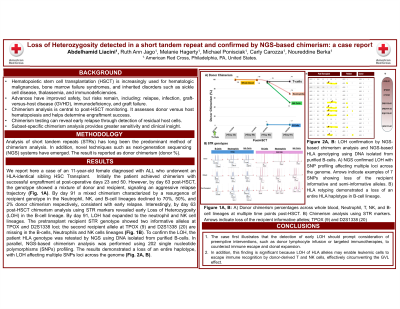
Body: We report here a case of an 11-year-old female diagnosed with ALL who underwent an HLA-identical sibling Hematopoietic stem cell transplantation (HSCT). Initially the patient achieved 100% donor chimerism with successful engraftment at post-operative days 23 and 50. However, by day 63 post-HSCT, the genotype showed a mixture of donor and recipient, signaling an aggressive relapse trajectory. By day 91 a mixed chimerism characterized by a resurgence of recipient genotype in the neutrophil, NK, and B-cell lineages declined to 70%, 50%, and 2% donor chimerism (Fig.1A), consistent with early relapse. Interestingly, by day 63 post-HCT chimerism analysis using short tandem repeat (STR) markers revealed early Loss of Heterozygosity (LOH) in the B-cell lineage. By day 91, LOH had expanded to the neutrophil and NK cell lineages. The pretransplant recipient STR genotype showed two informative alleles at TPOX and D2S1338 loci; the second recipient allele at TPOX (9) and D2S1338 (20) are missing in the B-cells, Neutrophils and NK cells lineages (Fig. 1B). To confirm the LOH, the patient HLA genotype was retested by NGS using DNA isolated from purified B-cells. In parallel, NGS-based chimerism analysis was performed using 202 single nucleotide polymorphisms (SNPs) profiling. The results demonstrated a loss of an entire haplotype, with LOH affecting multiple SNPs loci across the genome (Fig. 2A, B). These findings support the presence of LOH and further validate the chimerism results. This is significant because LOH of HLA alleles may enable leukemic cells to escape immune recognition by donor-derived T and NK cells, effectively circumventing the graft-versus-leukemia (GVL) effect. The patient ultimately experienced ALL relapse and succumbed to disease progression five months post-transplant.
Conclusion: The case first illustrates that the detection of early LOH should prompt consideration of preemptive interventions, such as donor lymphocyte infusion or targeted immunotherapies, to counteract immune escape and clonal expansion. In addition, this finding is significant because LOH of HLA alleles may enable leukemic cells to escape immune recognition by donor-derived T and NK cells, effectively circumventing the GVL effect.

.jpg "Abdelhamid Liacini, PhD F(ACHI) HCLD/CC(ABB) photo")