– Technical Specialist, SLUCare-SSM Health HLA Laboratory, United States
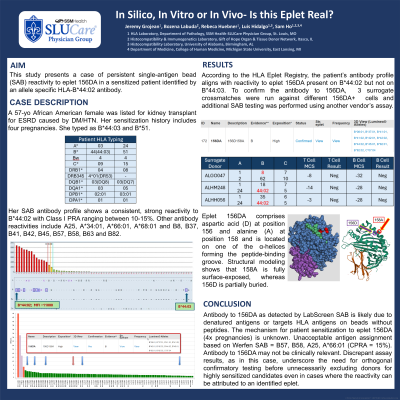
Body: Highly sensitized patients awaiting solid organ transplantation face extra challenges from false positive reactivities against denatured antigens on bead-based assays. We report a case of discrepant single-antigen bead (SAB) reactivity to eplet 156DA in a sensitized patient. A 57-yo African American patient diagnosed with type II diabetes mellitus and hypertension is listed for a kidney transplant. Her sensitization history includes 4 pregnancies. She was typed as B44 (B*44:03) and B51. Her SAB antibody profile shows a consistent, strong reactivity to B*44:02 with class I PRA ranging between 10-15% (Fig. 1A). Other antibody reactivities include A25, A*34:01, A*66:01, A*68:01 and B8, B37, B41, B42, B45, B57, B58, B63 and B82. According to the HLA Eplet Registry, this antibody profile aligns with reactivity to the eplet 156DA present on B*44:02 but absent from the patient’s own B*44:03 (Fig. 1B). To confirm, SAB testing with reagents from an alternative vendor was performed but failed to reproduce the 156DA pattern reactivity. Surrogate flow crossmatches against three 156DA+ donors (2 B*44:02, 1 B8) were consistently negative (Fig. 1C). Eplet 156DA comprises aspartic acid (D) at position 156 and alanine (A) at position 158 and is located on one of the α-helices forming the peptide-binding groove (Fig. 1D). Structural modeling shows that 158A is fully surface-exposed, whereas 156D is partially buried. According to the Eplet Registry 156DA is a confirmed, highly exposed eplet. However, the discrepant assay results between the SAB reagents and the cell-based flow crossmatches suggest that the 156DA reactivity observed with one of the SAB reagents may reflect nonspecific binding to denatured antigen epitopes.
Conclusion: Solid organ transplantation is rapidly moving towards the practice of virtual crossmatching in lieu of using cell-based assays for determining histocompatibility to expedite organ allocation. Virtual crossmatch accuracy requires accurate SAB assays, yet it is well known false positives occur due to denatured HLA proteins. In silico epitope/eplet analysis is an useful tool for verifying antibody specificities and predicting their clinical relevance. Our case corroborates the belief that not all eplets have been experimentally validated. Discrepant assay results, as in this case, underscore the need for orthogonal confirmatory testing before unnecessarily excluding donors for highly sensitized candidates.